Language
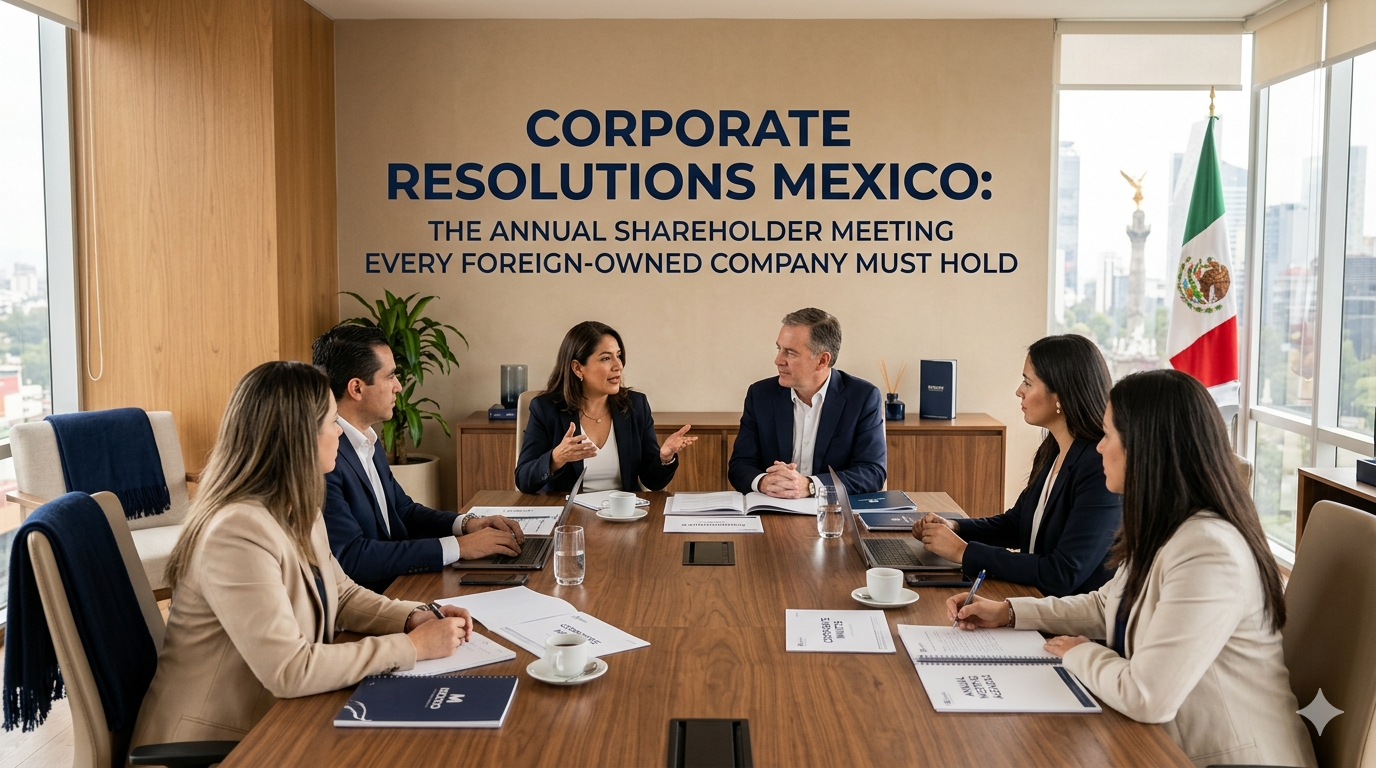
Most foreign owners of Mexican subsidiaries focus on operations and revenue and quietly overlook a requirement Mexican law treats as non-negotiable: the annual shareholder meeting. Whether your S.A. de C.V. or S. de R.L. de C.V. is run from Houston, Toronto, San Diego or Calgary, Mexican corporate law requires you to hold this meeting every year and to formalize the resulting corporate resolutions in your company's corporate books. Skipping it is not a paperwork issue, it can invalidate corporate acts, freeze dividend distributions, trigger fines, and complicate the bank account renewals your operation depends on.
The annual shareholder meeting (asamblea general anual) is the formal gathering where shareholders approve the prior fiscal year's results and make key governance decisions. Article 181 of the Ley General de Sociedades Mercantiles (LGSM) requires every S.A. de C.V. to hold this meeting at least once a year, within the four months following the close of the fiscal year. For companies on the calendar fiscal year, the vast majority, that means the meeting must be held no later than April 30. The same logic applies to a S. de R.L. de C.V. through its members' meeting (asamblea de socios) under Article 78 LGSM.
Under Article 181 LGSM, the annual meeting must, at minimum:
Article 194 LGSM requires these decisions to be entered as formal minutes (actas) in the company's official minute book (libro de actas). These minutes are the corporate resolutions Mexican authorities, banks and notaries will rely on every time your company acts.
The risks are operational and financial, not just formal:
Foreign shareholders rarely fly to Mexico to sign minutes and they don't have to. Mexican corporate law is flexible:
Most modern bylaws drafted for foreign-owned subsidiaries include the unanimous-resolutions clause specifically because it is the only practical way to operate from abroad. Even better, these can now be executed by electronic means (when the bylaws allow it). If your bylaws don't, the first remedial corporate act is to amend them.
The Código de Comercio (Articles 33 to 38) and the LGSM require Mexican companies to maintain official corporate books (libros corporativos):
These books must be kept physically, properly bound, and updated. Many foreign-owned subsidiaries still rely on legacy bookkeeping that fails audits and bank inspections, and that becomes a problem the moment a transaction, investor or bank asks to see them.
For companies on the calendar fiscal year, preparation should begin in February or March: closing the books, drafting financial statements, preparing the management report, issuing the meeting notice (convocatoria) in case of a meeting, coordinating powers of attorney from foreign shareholders, and scheduling signatures before April 30. Late filings can still be cured, but every day past the deadline creates exposure for any corporate act adopted after it.
Holding an annual shareholder meeting and formalizing the corresponding corporate resolutions Mexico law requires is not a clerical exercise, it is the legal foundation that keeps your subsidiary's acts valid, your dividend distributions clean, and your bank accounts open. At Singular Law, we manage the full annual compliance cycle for U.S. and Canadian-owned Mexican companies: drafting the convocatoria and minutes, coordinating powers of attorney from abroad, updating corporate books, and aligning corporate resolutions with tax and banking requirements. If your company has not yet held its 2025 annual meeting, contact our corporate team before the April 30 deadline turns into real exposure.
We're ready to help. Our team has a 24-hour response time.